

DND Amsterdam began with a proposal for LED screen surfaces across the dancefloor and connecting corridors. Refractiv developed the dancefloor concept around the room’s low ceiling and close viewing distances. Baranowitz+Kronenberg led the architecture and conceived the corridors.
The dancefloor needed a distinctive visual character and a system that could support different events. Its geometry helped determine the medium and the way it would move.
Look at the ceiling from the visitor’s position
The client supplied a ceiling height of approximately 260 centimetres, which Refractiv also measured on site. Visitors would stand close to the installed surfaces, with limited distance from which to see a flat image.
A distributed structure offered a different spatial arrangement. Light could occupy several angles and depths, with reflection extending the apparent field beyond the ceiling itself.
The design developed from that relationship between the physical room and the viewer. The aim was to create depth within the available volume.
Let mirrors extend the structure
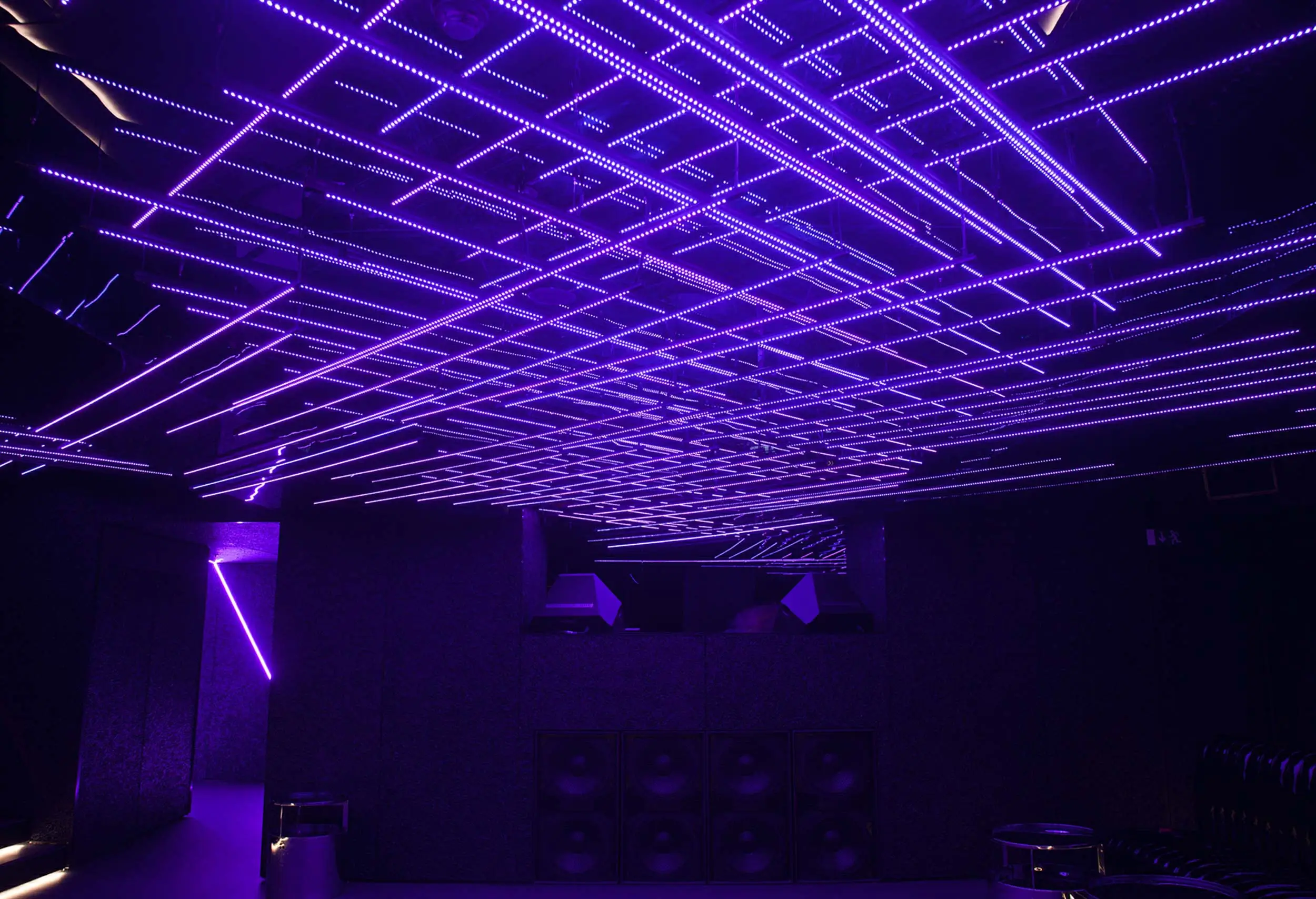
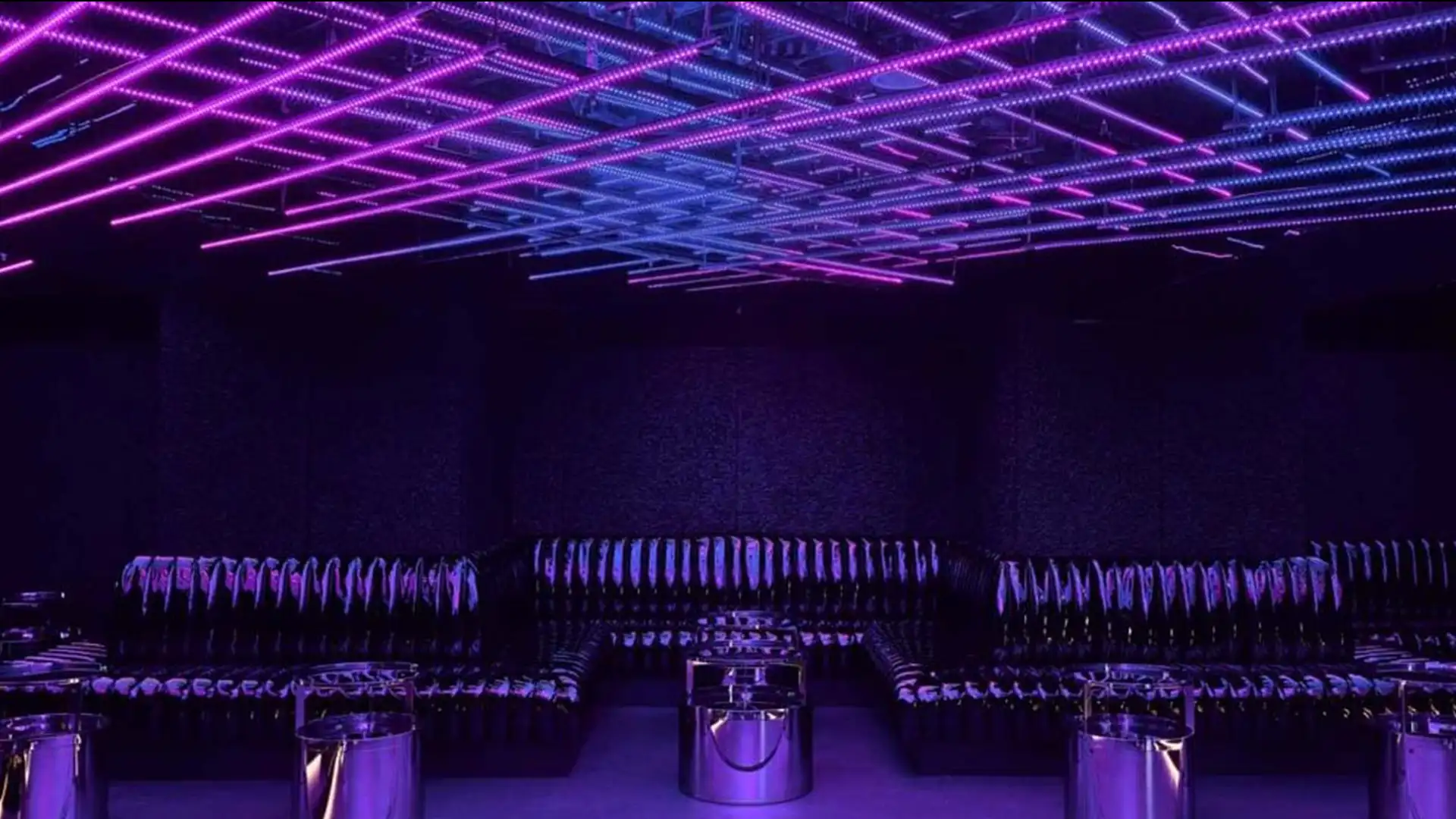
Approximately 150 custom addressable lighting elements, made in different lengths and specifications, form the active field. Mirrors repeat their lines and create overlapping views as people move.
The light bars produce the image; the mirrors extend its perceived depth. Their arrangement gives the room a layered visual structure that remains present as colours and sequences change.
References to Yayoi Kusama’s mirror environments helped communicate the perceptual principle during development. That reference concerned the effect of repeated light and reflection, with the DND structure designed for its own room and use.
Carry light through the corridors
Baranowitz+Kronenberg conceived the connecting corridors as passages through light. Refractiv realised that direction through fixture design, technical planning and programming.
The corridors and dancefloor share a relationship between light, reflection and movement. Their contributions remain distinct: the dancefloor lighting concept was Refractiv’s, and the corridor concept came from the architects.
Programme a three-dimensional field
Pixel-level control lets gradients and directional movement travel across the elements. Content is distributed through the room’s geometry, so changes in light can alter the apparent volume as well as its colour.
The programming supports different venue and music formats, including quieter and more active states. Staff with suitable lighting-programming knowledge can create, adapt and run looks within the control setup.
Refractiv’s documented scope included the dancefloor concept, fixture design, technical drawings, bill of materials, contractor instructions, programming and on-site supervision. The original commission was in 2017, with a refresh in 2024. The Entourage Group was the direct client and venue operator.
Make the constraint part of the brief
The ceiling height shaped the structure. Viewing proximity shaped the relationship between light and reflection. The venue programme shaped control and behaviour.
For another room, those conditions would lead to another response. The useful starting point is to examine how people occupy the space and what the installation needs to do through its daily use.
To discuss lighting for a venue or a constrained interior, contact Refractiv at Contact Refractiv.