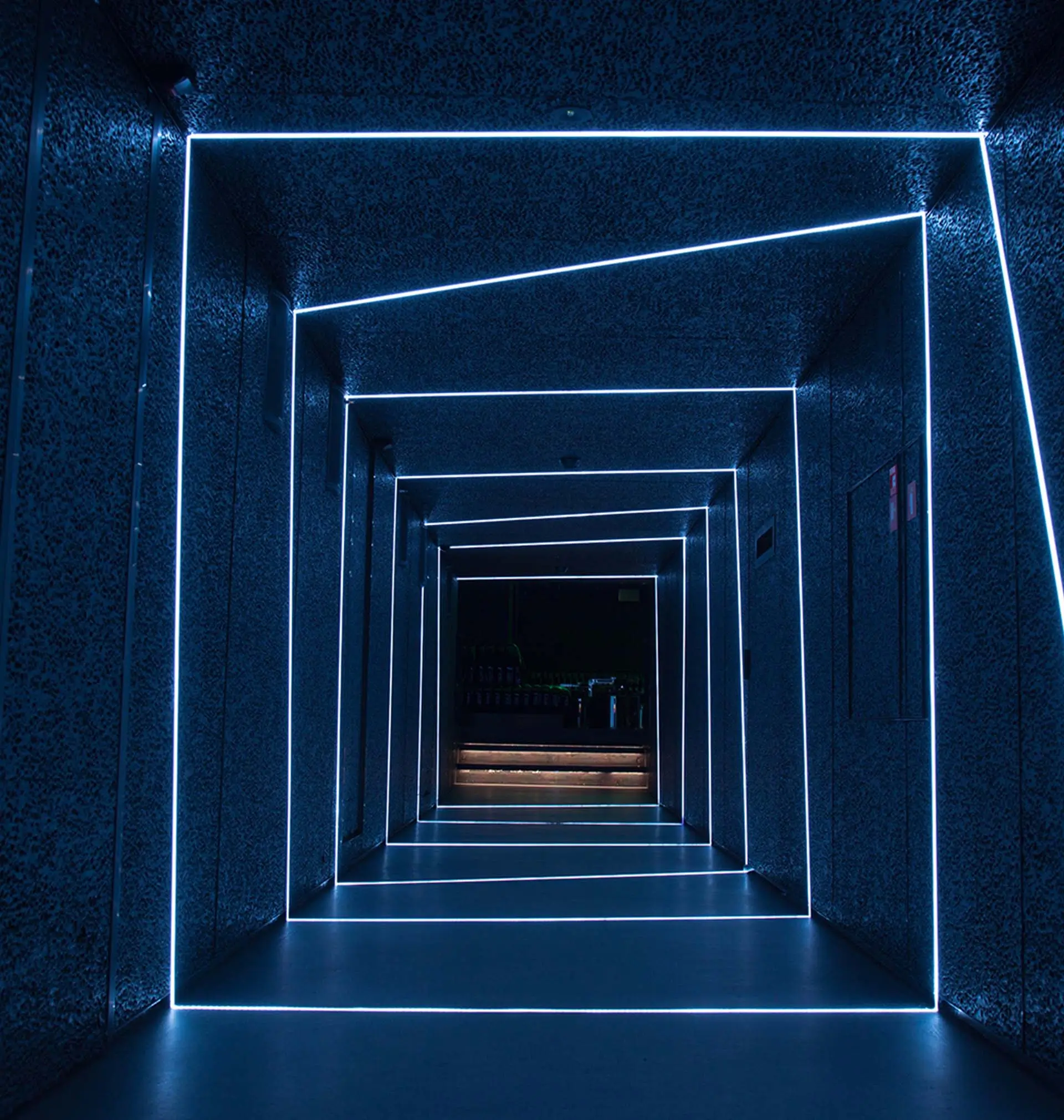
In a club or lounge environment, lighting is a technical and spatial layer. It changes how the space is perceived. It can compress or extend perceived depth, sharpen circulation, intensify energy, or create a slower atmospheric condition within the same room. Refractiv approaches club lighting as part of the spatial composition of the space, building a coherent luminous structure across it.
Starting from the room
That starts with the architecture. Ceiling height, material surfaces, mirror use, circulation paths, sightlines, and event format all shape what the lighting system should become. In some venues, the strongest result is a precise luminous structure that alters how the room is perceived, with light as the primary material.
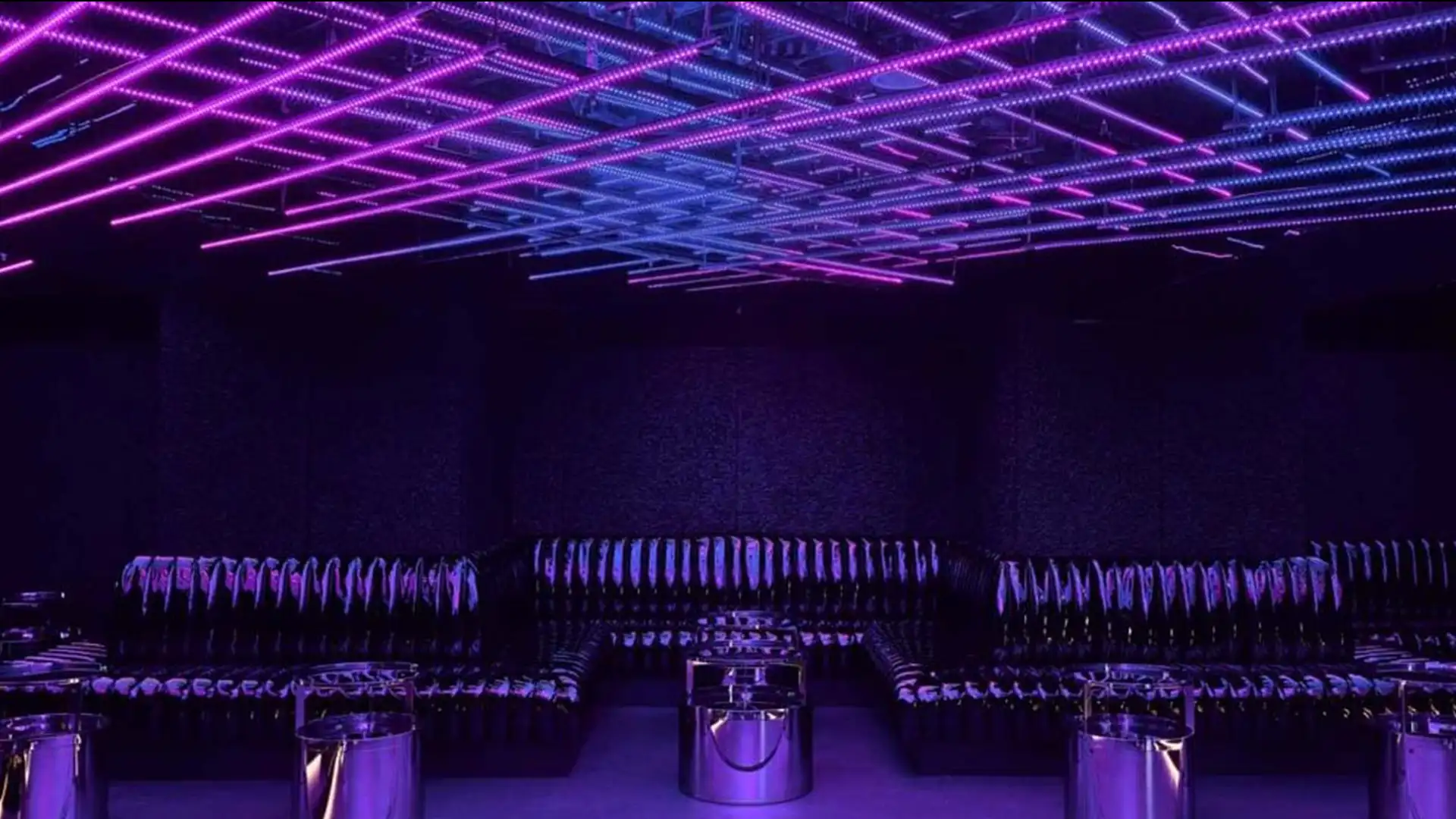
The work focuses on how custom lighting can generate form, depth, and movement in direct relation to the space. A club operates every night. The system has to produce high-impact visual conditions on demand while also sustaining long-term operation. Design must account for maintenance access, thermal limits, fixture longevity, and the reality of a venue built for nightly use over years.
Multiple operational states
A venue rarely operates in one mode only. The system needs to support ambient states during early hours, build through transitions, sustain peak-energy sequences, and handle day-to-day operation. Addressable LED control, pixel-level mapping, Art-Net or sACN distribution, and flexible scene logic make that possible, but only when they are designed around the actual use patterns of the venue.
In the strongest systems, the same hardware supports multiple identities. A Friday night condition, a Sunday lounge condition, a private event condition, and a maintenance state can all live inside one control structure. That flexibility is what allows a venue to evolve through programming and scene logic over time.
Two venues, two approaches
At DND Amsterdam, mirror geometry and addressable LED bars turned a low-ceilinged dancefloor into a layered field of light. The project is referenced here for its spatial constraint strategy.
Morph Rooftop Bar shows the same principle applied to a lounge environment. There, lighting was developed as part of the wider spatial atmosphere, with addressable control allowing the venue to move between ambient evening use and more active event conditions. The system shares logic with the broader media environment and participates in one spatial framework.
In both cases, the light layer gives the venue a usable and recognisable spatial identity.