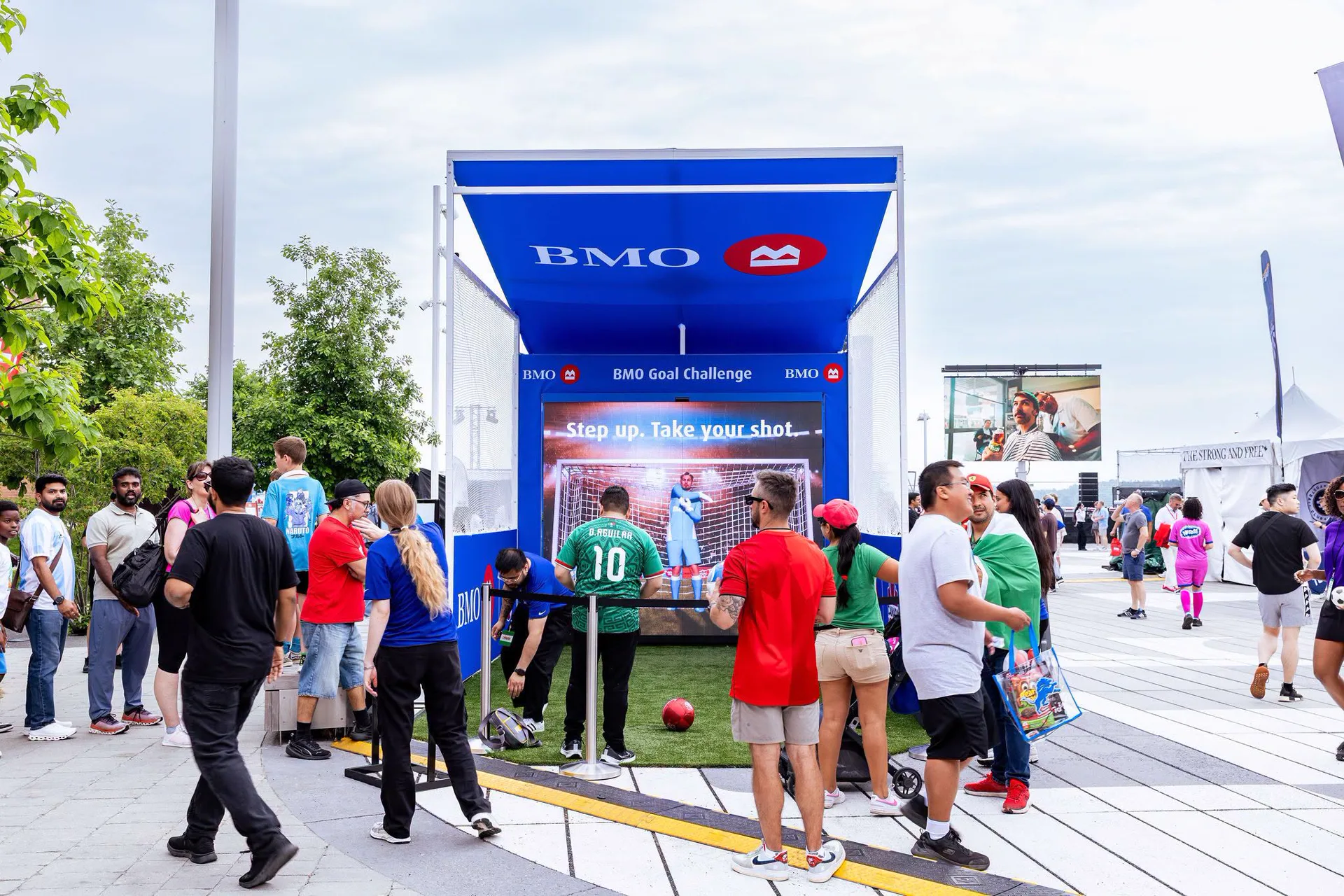
A player steps forward, strikes a ball and sees a goalkeeper respond on a large LED goal. The visible interaction lasts a few seconds. Its credibility depends on a system that reads the action, decides the outcome and presents the result within one continuous moment.
The BMO Goal Challenge applied this structure at outdoor fan zones in Toronto and Vancouver during June and July 2026. Refractiv designed the interaction and system architecture, developed the sensing and game logic, specified hardware, prepared installation drawings and supported supervision, training and operation.
Stingray and Commersive held the concept and event-production roles. Commersive delivered physical production, the LED wall and AV installation.
Reading a fast action outdoors
A struck ball crosses the play area quickly and remains in continuous motion. Camera tracking therefore needs capture settings, field of view and processing matched to the speed and geometry of the shot.
The outdoor environment adds changing light. Direct sun, cloud and dusk alter exposure and contrast through the event day. People also move around the goal and play area. The tracking pipeline has to identify the ball while excluding surrounding activity and retaining weak or imperfect shots as valid attempts.
The system's capture design therefore follows the complete range of expected play. Tests need to include different shot speeds, trajectories, players, light conditions and background movement.
Verifying the outcome
Camera tracking describes the movement of the ball. Verified impact sensing supplies a second form of evidence at the goal surface. The game logic combines these inputs to determine the outcome presented on the LED wall.
Each sensing method contributes evidence to the result. Their relationship is established through calibration and game logic, allowing the system to evaluate a genuine attempt consistently.
Controlling the response time
The response needs to arrive while the player still reads the kick and the goalkeeper's action as one event. This creates an end-to-end time budget across capture, processing, game logic, visual rendering and the LED display.
Every stage contributes delay. The display is part of the system budget alongside the software. Technical validation measures the complete path at the installed site and uses that result to guide processing, animation and output choices. Detailed measurements remain part of the project documentation.
Calibrating each site
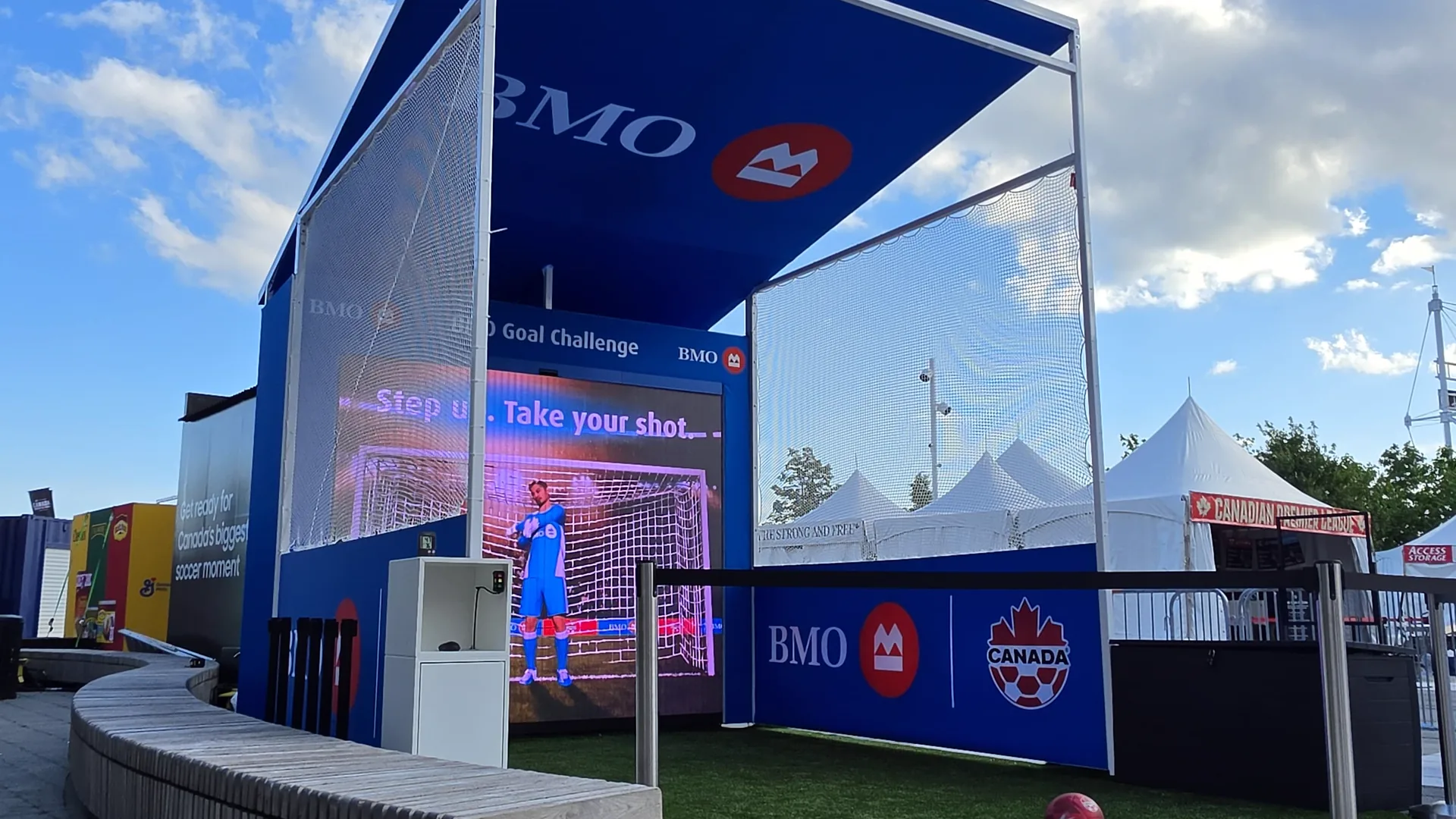
Toronto and Vancouver used the same experience structure in different physical conditions. Each site required calibration between the camera view, the impact surface and the coordinates used by the game logic.
A repeatable calibration process supports setup and recovery. It defines the reference geometry, confirms sensor response and tests representative shots before public operation. If a component moves or conditions change materially, operators and the remote support team have a known route back to the validated state.
Designing for repeated public use
The experience resets quickly for the next player and runs across multiple match days. Event staff operate the installation, with remote support available for diagnosis. Operator controls, status information and recovery procedures therefore form part of the delivered system.
Consistency matters across the full event, from the first player at one site to the final day at the second. Sensing, game logic, output and operation all contribute to that consistency.
A transferable system pattern
The same design demands apply to other fast physical actions: capture matched to speed, evidence matched to the outcome, a defined response-time budget, site calibration and an operating model for repeated use. The specific sensors and rules change with the activity, geometry and desired result.
For a fast-action interactive system, sensing study or public-experience prototype, contact Refractiv.
Related project: BMO Goal Challenge. Related capabilities: Sensing and Spatial Response and Commissioning and Lifecycle Support.