

Give the visit a sequence
A pavilion has a defined footprint and a limited period of use. Its approach, interior and focal moments need to work together. We develop how people enter, what draws their attention and how the product or story becomes part of the experience.
Image, light and interaction can guide that journey, from an ambient arrival to a focused encounter or reveal.
Connect architecture and media
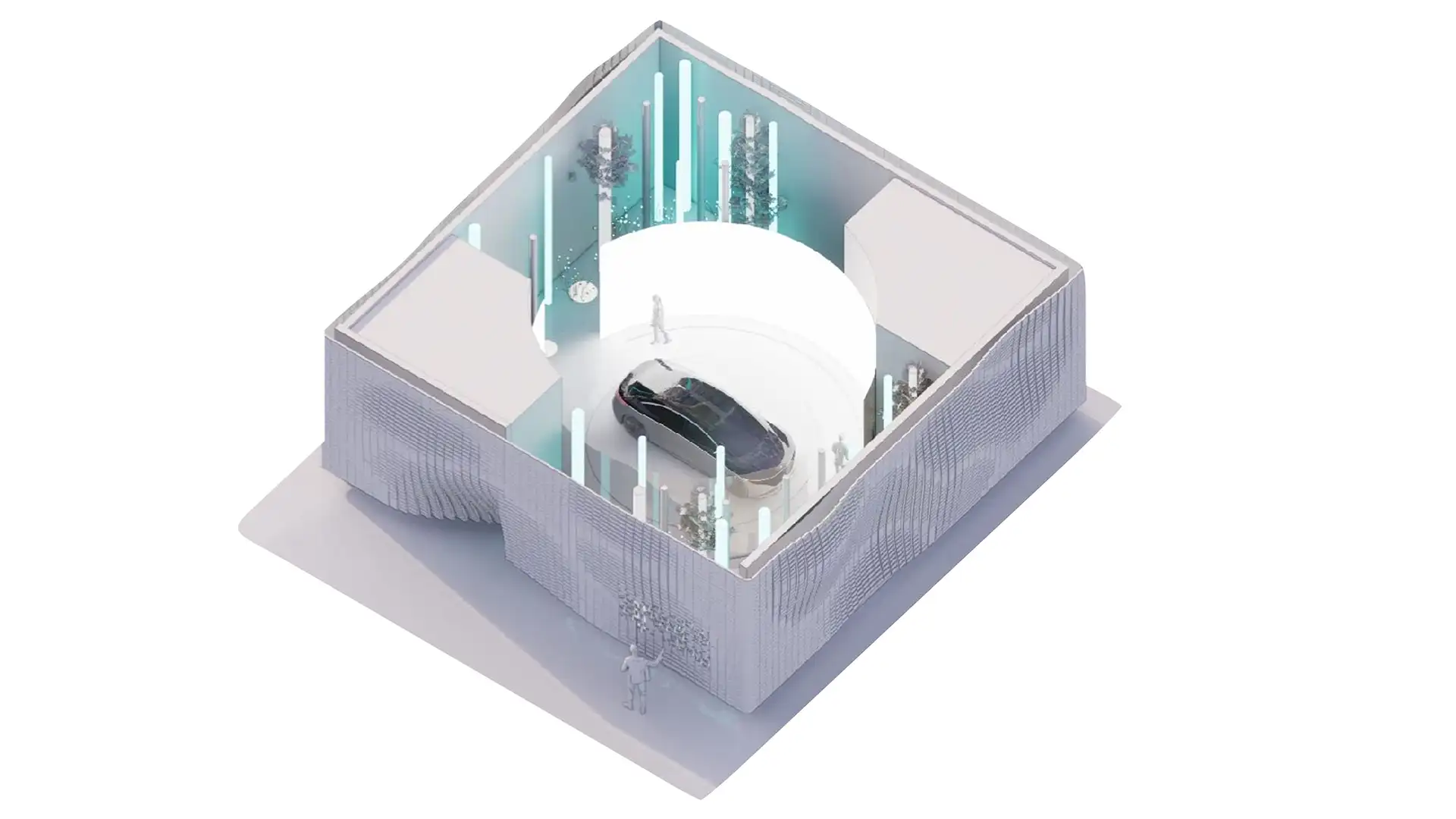
In the Mercedes-Benz EQS concept, a digital forest and programmable light formed the approach to a panoramic environment around the vehicle. Refractiv developed the spatial and media direction, interaction concept and handover package for Uniplan China.
The concept defined relationships between the physical form and changing content. A third-party vendor later realised the pavilion under Uniplan China’s supervision.
Work within a clear team structure
Refractiv can develop the media concept and visual behaviour or contribute a defined layer within a larger installation. At Lexus A-Un, that contribution was the butterfly visual design, animation and programming within Aircord’s framework.
The brief should identify responsibilities for architecture, structural work, fabrication, AV, content and operation. Those boundaries help carry the creative direction into production.

Plan for the event format
Audience flow, the presentation schedule and installation access shape the work. A touring pavilion also needs an approach to changing geometry, setup and calibration at each location.
Share the brand story, site or proposed footprint and event timing. We can develop the concept and define which parts of the experience belong within the commission.
Discuss a pavilion: Contact Refractiv.